
Manukau Ranges: A Planners Sandbox indeed!
Introduction: The Unpredictable Life of a Digital Mayor
Every Cities: Skylines player knows the feeling. One moment, you’re admiring a perfectly zoned neighbourhood; the next, you’re staring at a hundred little icons screaming about a garbage crisis, a collapsed power grid, or a mysterious city-wide thirst for beverages. It’s the beautiful chaos of creation, where complex systems interact in ways you never anticipated.
The Manukau Ranges project, a sprawling megalopolis built from the ground up, became a masterclass in these unexpected challenges. What started as a standard city-building exercise evolved into a deep dive into the game’s complex simulation engine. This article distils the five most surprising and counter-intuitive lessons learned from managing this digital metropolis, offering insights that blend practical gameplay tactics with real-world urban planning principles.
The video below is an AI summary of the Manukau Ranges series both here in this blog and on my YouTube channel!
Carrying on
1. You Have to Play God with the Economy (But Avoid Becoming a Soviet Planner)
In a crisis, a digital mayor can’t just wait for the market to correct itself. Direct economic intervention is sometimes the only way to pull your city back from the brink. The “beverage crisis” in Manukau Ranges was a perfect example. Despite having the necessary infrastructure, the city was simply not getting enough beverages. “You thirsty Sims,” I thought, looking at the warning icons.
The solution was to perform a delicate balancing act. By applying government subsidies to both the production and commercial sectors for beverages, we could stimulate the entire supply chain. It was a targeted injection of capital designed to get a specific industry moving again. However, this power requires surgical precision. While dealing with the beverage shortage, the city also had an oversupply of petrochemicals. Stimulating the entire industrial sector would have fixed the beverage problem but made the petrochemical glut even worse. The challenge wasn’t just to boost one industry, but to do so without destabilizing another.
This is where the game teaches a crucial lesson about the dangers of over-intervention. A gentle, targeted nudge can fix a market failure but trying to micromanage every facet of production leads to wild instability.
…then your industry will start doing a spike and dip everywhere and it’s like you’re playing Soviet planning control and it’s like uh this is not working and no it’s not going to work.
The key takeaway is the difference between targeted economic stimulus and a full-blown command-and-control economy. One is a scalpel; the other is a sledgehammer.
2. Your Citizens Have a Mind of Their Own, Especially About Housing
One of the most frustrating moments came when establishing the small industrial town of Huntly. Despite skyrocketing residential demand, the newly built medium-density housing sat stubbornly empty. The Sims simply refused to move in, creating a perplexing shortage-amidst-surplus situation.
…there is housing they’re just choosing not to go with what they want which ends up becomes a bit annoying because then you have all this empty housing…
The problem wasn’t a lack of housing; it was a lack of the right housing. The initial approach zoning standard medium-density and even some experimental European-style apartments did nothing. The buildings went up, but the demand meter stayed pinned in the red. Then, in a moment of trial and error, I zoned a few blocks of “row housing.” The effect was immediate. “Oh, it’s actually going to attract people,” I exclaimed as the construction icons finally turned into occupied homes. “Well, there we go.”
For reasons known only to the simulation’s algorithm, this specific type of development was what the citizens craved. This is a surprising lesson because it reveals that meeting demand isn’t just about numbers. A successful mayor must also pay attention to the preferences and styles that the simulation favours, even when those preferences seem completely arbitrary.

3. A Perfect Plan Is a Myth; a Good Fix Is Everything
No matter how carefully you map out your city, unexpected problems are inevitable. Drawing from my real-world planning experience, I laid out the initial infrastructure for Manukau Ranges with care, but reality hit almost immediately. The first residents had barely moved in when the entire sewer system overloaded, an immediate crisis that demanded an immediate fix. I was forced to build the advanced sewage treatment plant far ahead of schedule, a costly but necessary deviation from the plan.
This set the tone for the entire project: building a city isn’t a single act of creation but a continuous cycle of identifying problems and implementing fixes. The game mirrors real-world urban development, where unforeseen consequences and shifting needs demand constant adaptation. The decisions are not always end up good Some of them end up a bit of a bit of a crapshoot that you work through it, and you fix them up.
Embracing this reality is crucial. A simple mantra guided the later stages of development: “if you make a mistake don’t forget to correct it nothing wrong with that”. The true skill of an expert planner in Cities: Skylines 2 isn’t in creating a flawless blueprint from the start, but in developing the resilience and adaptability to fix what breaks along the way.
4. Mods Aren’t Just Cheats; They Can Be Lifesavers
While the ideal game experience is one that works perfectly out of the box, the modding community plays a critical role in the Cities: Skylines 2 ecosystem. My philosophy remains that “the more the game gets itself in order and the less I have to run mods to do it the better I think it will be.” But sometimes, a mod is the only thing standing between you and a city-ending bug.
This became dramatically clear when the Manukau Ranges simulation slowed to an unplayable crawl. I feared the worst. “I thought the city was done for pretty early,” I admitted, worried the entire project was unsalvageable. The cause turned out to be a corrupted game state. The city’s actual population was around 286,000, but the simulator was tracking 2.86 million entities—a horde of “ghost” citizens ten times the living population that was grinding the engine to a halt.
The city was on the verge of being abandoned until the “Citizen Entity Cleaner” mod was installed. This “little nifty tool” scanned the save file, cleaned up the corrupted data, and restored the city’s performance. It wasn’t a cheat; it was a lifeline. This illustrates that many popular mods are essential “back stops” that patch or enhance core game mechanics, acting as a crucial safety net for players.
5. Real Urban Planning Theories Actually Work
As an IRL planner, the design of Manukau Ranges was never random. The city was built as a test bed for established urban planning theories, and the game’s sophisticated simulation proved remarkably receptive to them.
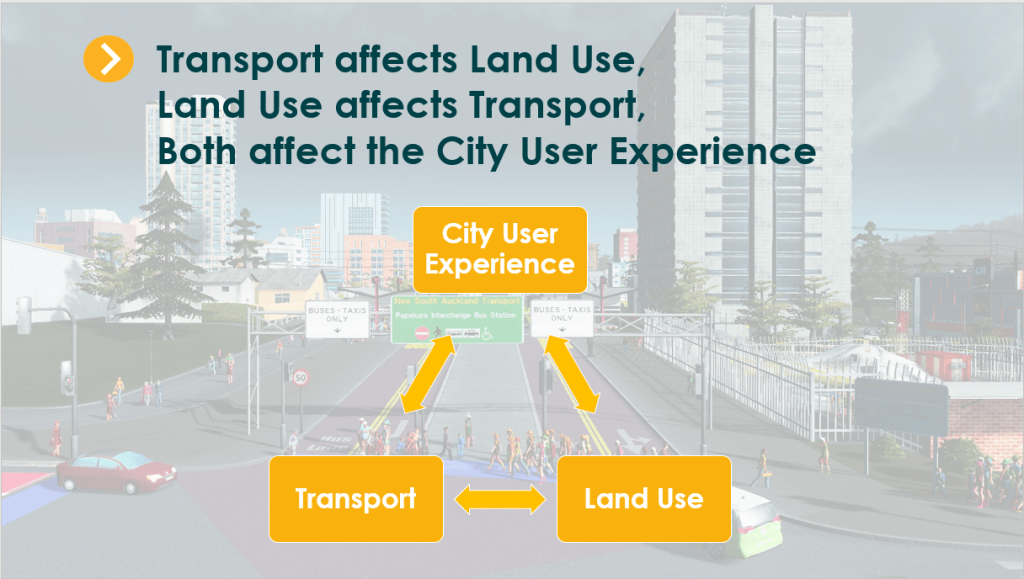
Instead of a simple grid, the city was based on a “composite urban model,” featuring a primary core supported by several smaller, self-sufficient centres. Development was heavily focused on “Transit-Oriented Developments” (TOD), a core principle in modern urbanism. This theory was applied directly: the high-density commercial and residential heart of the Manukau city centre is clustered tightly around its primary transport hub, which integrates “the central station, an accompanying metro station, and the tram/bus mall.”
The goal of this approach was to create a vibrant, “24/7 economy”—a city that feels alive around the clock, rather than a sterile 9-to-5 downtown that empties out at night. Applying these real-world principles elevates the game from a simple sandbox builder into a complex and rewarding simulation. It demonstrates that the game’s engine is robust enough to model the intricate social and economic behaviours that shape actual cities, offering deeper challenges and more satisfying results.
Conclusion: Your City Is the Best Teacher
Cities: Skylines 2 is far more than just a game. It’s a dynamic simulator that serves up unexpected and powerful lessons in economics, sociology, and engineering with every session. Building a city like Manukau Ranges reveals the hidden depths of its systems, forcing you to adapt, experiment, and learn from your mistakes. In the end, the most valuable guide isn’t a tutorial or a wiki, but the city itself.
What’s the most surprising lesson your city has taught you?
 Ben's Cities